Every seasoned leader eventually encounters the overt cultural saboteur: the individual who aggressively repudiates strategy, openly defies decisions, or causes visible friction across the boardroom table. As painful as those situations appear, they are structurally straightforward. You can point directly to the breach, reference code of conduct policies, and initiate standard performance or disciplinary management.
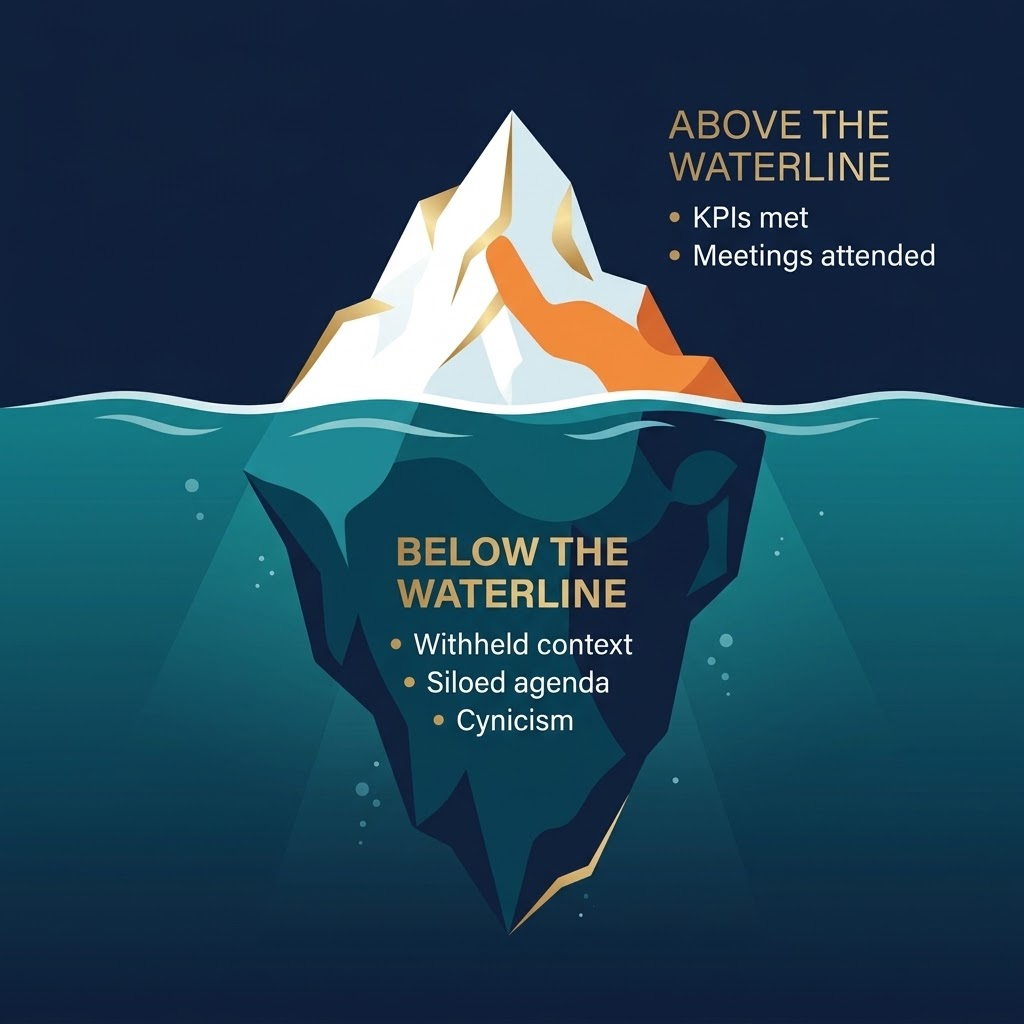
The far more pernicious trial—and the true test of executive leadership—is the team member whose non-alignment exists almost entirely below the waterline.
They appear on time for meetings. Their operational deliverables pass surface inspection. On paper, their status reports are marked green. Yet, across weeks and months, you observe an unmistakable shift: they have ceased showing up in any way that matters. Beneath a veneer of measured compliance, an alternate current is running—a private agenda detached from, or subtly working against, the organisation’s mission, vision, and core values.
The dilemma is agonising: the behaviour remains deliberately low-grade and deniable, making specific, objective evidence frustratingly difficult to pin down. If you call it out prematurely without hard metrics, you risk being branded micromanaging, subjective, or paranoid. If you ignore it, you quietly license the slow unraveling of your team’s cultural fabric.
The Anatomy of the Sub-Surface Agenda
When an individual operates to a private agenda while occupying a seat of responsibility, they rarely commit a fatal, visible error. Instead, their non-alignment manifests as a collection of micro-behaviours:
- Selective Compliance: They execute the absolute letter of their remit while consistently withholding discretionary effort, collaborative goodwill, and cross-functional generosity.
- Corrosive Passivity: In strategic forums where their functional expertise should challenge and shape direction, they offer passive agreement or complete silence, saving their candid, critical opinions for corridor conversations and private one-to-one channels.
- Territorial Protectionism: Decisions that advance the collective mission are gently delayed or quietly deprioritised whenever they do not serve the individual’s immediate career leverage, standing, or internal political footprint.
- The "Malicious Neutrality" Mask: When unexpected crises arise, they step back just far enough to avoid accountability, observing team hurdles with detached curiosity rather than collective ownership.
As Olympic swimming coach Bob Bowman once reflected on elite team standards, achieving greatness requires having the right people in the right seats who buy into something larger than themselves; if someone cannot or will not carry out the shared mission, they ultimately have to move on. Bowman noted that sustained success is grounded in "showing up day in, day out, consistently"—not solely in terms of physical presence, but through shared effort and attitude. When a colleague withholds that foundational commitment, the vacuum is felt immediately.
The Unspoken Tax on the Collective
Leaders often delay addressing sub-surface dissent because they assume an unevidenced issue causes minimal outward damage. This is a critical miscalculation.
High-performing teams possess acute emotional and operational antennae. Peers observe the guarded posturing in sprint reviews; they notice who routinely withholds vital context until forced; they recognise who is building an independent fiefdom rather than serving the shared charter.
When leadership fails to address this dynamic, three destabilising consequences follow:
- Erosion of Psychological Safety: The team begins spending precious cognitive bandwidth navigating interpersonal politics and second-guessing intentions, rather than solving complex commercial problems.
- Resentment Among the Committed: Your most dedicated contributors—those who actively sacrifice personal credit to advance the broader mission—watch a colleague receive parity of reward and standing while contributing a fraction of the emotional and collaborative labour.
- The Silent Downgrade of Cultural Standards: The true culture of an organisation is not defined by the values painted on office walls, but by the worst behaviour a leader is willing to tolerate. By allowing someone to operate to an unaligned agenda simply because it is difficult to formalise, you implicitly reset the baseline for everyone else.
Moving from Ambiguity to Action: Resolving the Dilemma
Addressing behaviour that skirts beneath the waterline requires a shift away from prosecuting motives and toward illuminating expectations. When you cannot easily evidence intent, you must rigorously benchmark alignment.
1. Shift the Focus from "Outputs" to "Outcomes and Interdependence"
If an unaligned colleague hides behind baseline task completion, alter the criteria of evaluation. Performance in modern organisations cannot be reduced solely to individual velocity; it includes how effectively an individual enables collective progress. Bowman emphasised evaluating whether an individual actively makes the people around them better. Define collaborative standards—such as knowledge sharing, peer mentorship, and cross-silo enablement—as non-negotiable operational requirements, not optional cultural perks.
2. Call Out the Pattern, Not the Suspected Motive
Never enter a conversation accusing an employee of having a "hidden agenda" or "poor attitude." Those terms invite immediate, defensive debate over subjective feelings and plausible deniability. Instead, anchor the feedback strictly to observable patterns:
"In our last three strategic steering sessions, you raised no objections during the plenary discussions, yet you subsequently told two peers that the agreed direction was unviable. That disconnect between your presence in the room and your actions outside it stalls our momentum. Talk me through what is happening there."
By holding a mirror up to the gap between their public participation and their practical behaviour, you remove room for evasive manoeuvring.
3. Anchor Disagreement Directly to Organisational Values
Organisational values must function as decision-making guardrails rather than aspirational prose. If one of your values is transparency, challenge their guardedness. If it is enterprise-first ownership, interrogate decisions that disproportionately protect their team's perimeter at the expense of enterprise objectives. Ask directly: "How does the approach you took on Project X align with our commitment to shared ownership?" Let them undertake the intellectual work of reconciling their actions with the broader vision.
4. Establish Radical Clarity Around Mutual Commitment
Ultimately, every leader must present unaligned operators with a clear, professional choice. Acknowledge that exceptional work requires total alignment with the journey ahead. If their personal ambition, working philosophy, or professional trajectory has diverged from where the business must go, frame that reality with dignity and clarity. Offer a path back into authentic engagement, but remain unambiguous that remaining passively detached on the fringes of the team is no longer an available option.
The Cost of Courage
Tackling sub-surface misalignment is an uncomfortable, draining leadership discipline. It requires lean-in courage, rigorous observation, and the willingness to manage high-stakes friction before an overt crisis forces your hand.
However, your mandate as an impactful leader is not to maintain a fragile, superficial peace. Your obligation is to safeguard the collective integrity of the team and steward the mission entrusted to you. When someone quietly stops showing up for the shared cause, the kindest and most effective act of leadership you can perform—for the organisation, the wider team, and ultimately the individual themselves—is to pull the conversation directly above the waterline.
What strategies do you employ when addressing behaviours that sit just beneath the waterline? How do you distinguish between constructive, independent thinking and an agenda that actively works against the team?